Collocated Mode#
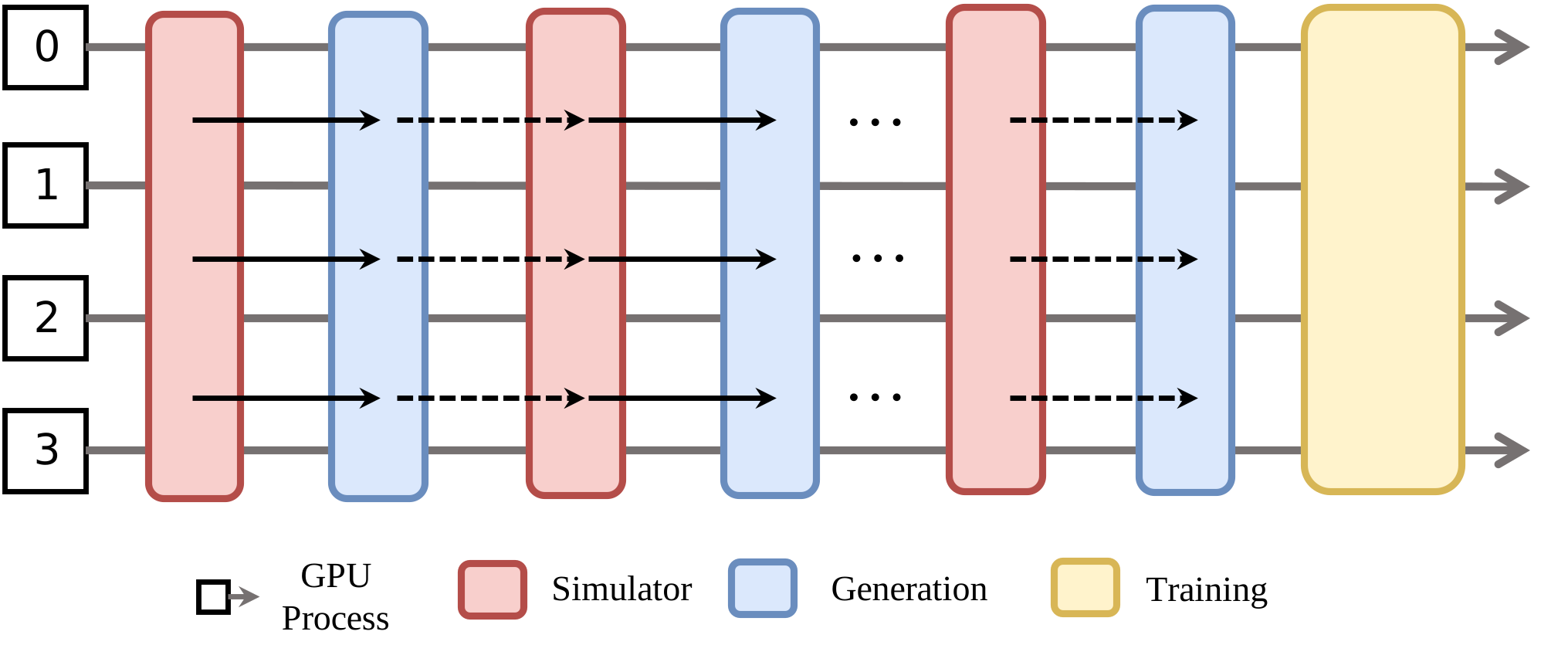
All workers are scheduled on the same set of GPUs. During any stage only one type of worker runs and occupies the entire devices’ computation capability until that stage finishes. There two execution modes: residing in GPU memory simultaneously or switching residence in GPU memory with offloading/reloading.
Pros
Simple design; no complex data-dependency management.
Cons
Often requiring offloading/reloading implementation for each component.
Long-tail latency in the rollout stage extends end2end RL training time.
Example configuration
The following is an example of placing workers. There are two nodes for this training job, each node has 8 GPUs. actor uses all the 16 GPUs and rollout also uses all the 16 GPUs:
cluster:
  num_nodes: 2
  component_placement:
    actor,rollout: all # or 0-15
Additonally, some workers support offloading to release GPUs to other workers during some time period. For example, math RL actor support some offloading options:
actor:
  offload_optimizer: True
  offload_weight: True
  offload_grad: True
If offloading is enabled for actor, the actor is loaded into GPU memory before it runs, then it is offloaded into CPU memory after it finishes its execution. If offloading is not enabled, the collocated workers (assuming workers run on GPUs) will compete for GPU memory, which may lead to OOM error. Refer to YAML Configuration for the complete configuration.
ComponentPlacement programming
Given the above placement configuration, users can use proper ComponentPlacement class to parse the configuration and enforce the placement to the workers as below.
from rlinf.utils.placement import ModelParallelComponentPlacement, PlacementMode

component_placement = ModelParallelComponentPlacement(cfg, cluster)
rollout_placement_strategy = component_placement.get_strategy("rollout")
rollout_group = SGLangWorker.create_group(cfg, component_placement).launch(
     cluster,
     name=cfg.rollout.group_name,
     placement_strategy=rollout_placement_strategy,
 )
ModelParallelComponentPlacement supports two types of placement: collocated and disaggregated. More importantly, it deals with rank arrangement that allows efficient model weight update from training to rollout. It parses the configuration and generates placements for different components. The generated placement is then enforced during worker launching.
Refer to Math RL training python script for the complete code.