
Flow Matching Policy Training with SAC#
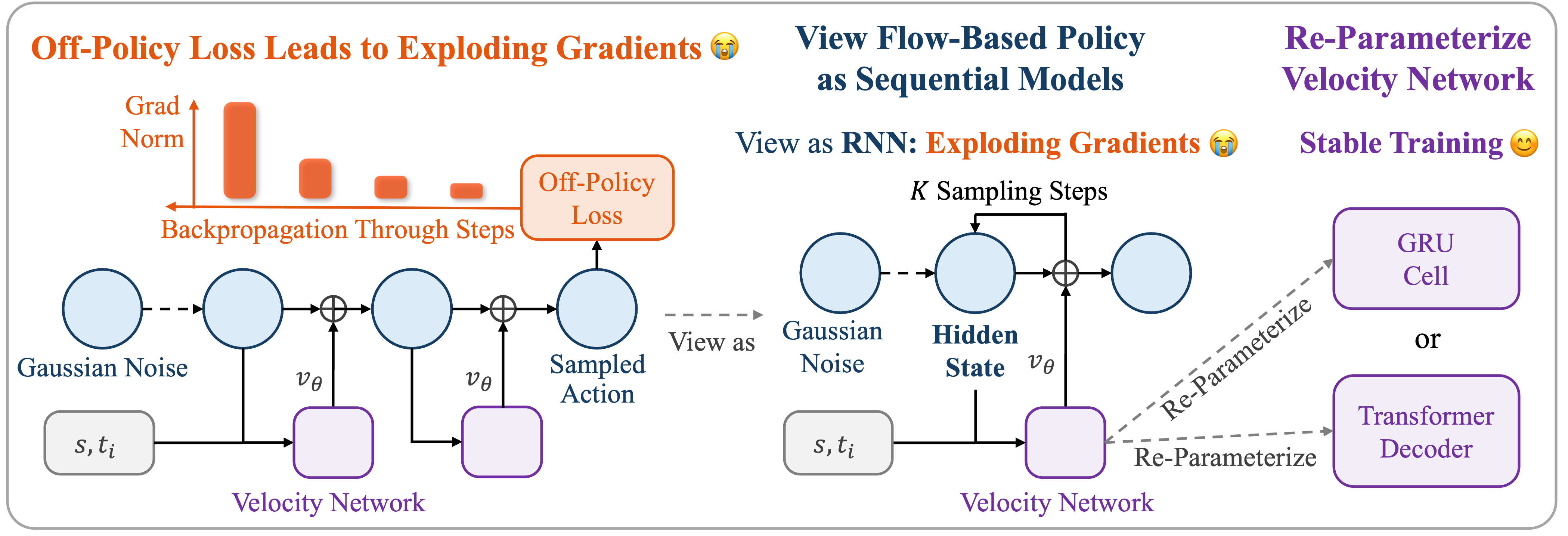
SAC-Flow overview.#
Train a Flow Matching policy network with SAC (Soft Actor-Critic) in simulation or on a real robot. The method combines maximum-entropy reinforcement learning with generative flow matching models.
Overview#
Train a Flow Matching policy with SAC — in ManiSkill simulation or on a real Franka (peg insertion).
SAC · RLPD
Flow Matching policy
ManiSkill · Franka
Sim & Real
env/success_once.Tasks#
Setting |
Environment & task |
Observation |
Action |
|---|---|---|---|
Simulation |
ManiSkill3 — |
Joint angles + object state |
4-dim: 3D position + gripper |
Real world |
Franka Panda + RealSense — peg insertion |
RGB + proprioception |
6-dim end-effector pose |
How SAC-Flow Works#
Core Algorithm Components
SAC (Soft Actor-Critic)
Learns Q-values through the Bellman equation and entropy regularization.
Uses a Flow Matching network as the Actor policy.
Learns a temperature parameter to balance exploration and exploitation.
Flow Matching Policy
Velocity Network Parameterization: Treats the K-step sampling of the flow policy as an RNN, replacing the velocity network in the flow policy with a recurrent modern Transformer architecture to solve training stability issues.
Log-Likelihood Calculation: Adds Gaussian noise + corresponding drift correction in each sampling step to ensure the terminal action distribution remains unchanged, while decomposing the path density into a product of single-step Gaussian likelihoods, thereby obtaining a differentiable \(\log p_{\theta}(A|s)\) .
RLPD (Reinforcement Learning with Prior Data)
A variant of SAC that combines offline data and online data for training.
To accelerate training in the real world, SAC-Flow can also be used with RLPD using pre-collected offline data as a demonstration buffer.
Installation#
For running in a simulation environment, please refer to Installation for installation.
For running on real hardware, please refer to Real-World RL with Franka for installation and hardware configuration.
Run It#
1. Configuration Files
RLinf provides default configuration files for both simulation and real-world environments:
Simulation (ManiSkill):
examples/embodiment/config/maniskill_sac_flow_state.yamlReal World (Franka):
examples/embodiment/config/realworld_sac_flow_image.yaml
2. Key Parameter Configuration
2.1 Model Parameters (Model)
actor:
  model:
    model_type: "flow_policy"
    # Input type: 'state' (simulation) or 'mixed' (real world, image+state)
    input_type: "state"

    # Flow Matching related parameters
    denoising_steps: 4  # Number of denoising steps for action generation
    d_model: 256        # Transformer dimension
    n_head: 4           # Number of attention heads
    n_layers: 2         # Number of layers
    use_batch_norm: False  # Whether to use Batch Normalization
    batch_norm_momentum: 0.99  # Batch Normalization momentum
    flow_actor_type: "JaxFlowTActor"  # JAX style "JaxFlowTActor" or torch style "FlowTActor". "JaxFlowTActor" supports the following noise std settings:
    noise_std_head: False  # Whether to use a separate head to predict noise std, otherwise use fixed std
    # Noise std used during inference (rollout) can be smaller than during training to balance exploration and exploitation
    log_std_min_train: -5  # Min log std during training (if using noise_std_head)
    log_std_max_train: 2   # Max log std during training (if using noise_std_head)
    log_std_min_rollout: -20  # Min log std during rollout (if using noise_std_head)
    log_std_max_rollout: 0    # Max log std during rollout (if using noise_std_head)
    noise_std_train: 0.3  # Fixed noise std during training (if not using noise_std_head)
    noise_std_rollout: 0.02  # Fixed noise std during rollout (if not using noise_std_head)
2.2 Algorithm Parameters (Algorithm)
algorithm:
   # SAC Hyperparameters
   gamma: 0.96          # Discount factor
   tau: 0.005           # Target network soft update coefficient
   entropy_tuning:
      alpha_type: softplus # Entropy coefficient parameterization
      initial_alpha: 0.01  # Initial entropy coefficient
      target_entropy: -4
      optim:
         lr: 3.0e-4     # Entropy coefficient learning rate
         lr_scheduler: torch_constant
         clip_grad: 10.0
   critic_actor_ratio: 4  # Ratio of Critic to Actor training steps

   # Training and Interaction Frequency
   update_epoch: 30     # Number of training steps after each interaction
2.3 Cluster and Hardware Configuration (Cluster)
For real-world training, use a multi-node configuration, deploying the Actor/Policy on a GPU server and the Env/Robot on a control machine (NUC/Industrial PC). Specific configurations can be found in Real-World RL with Franka.
3. Launch Commands
Simulation Training (ManiSkill)
Launch simulation training on a single machine:
bash examples/embodiment/run_embodiment.sh maniskill_sac_flow_state
Real World Training (Franka)
Launch real-world training in a distributed environment (needs to be run on the master node with cluster configured):
bash examples/embodiment/run_realworld_async.sh realworld_sac_flow_image
Visualization and Results#
1. TensorBoard Logs
# Start TensorBoard
tensorboard --logdir ./logs
2. Key Monitoring Metrics
For metric definitions, see Training metrics. SAC-relevant metrics:
Environment Metrics:
env/episode_len: The actual number of environment steps in the episodeenv/return: Total return of the episodeenv/reward: Step-level reward from the environmentenv/success_once: Flag indicating at least one success in the episode (0 or 1)
Training Metrics:
train/sac/critic_loss: Loss of the Q-functiontrain/critic/grad_norm: Gradient norm of the Q-functiontrain/sac/actor_loss: Policy losstrain/actor/entropy: Policy entropytrain/actor/grad_norm: Gradient norm of the policytrain/sac/alpha_loss: Loss of the temperature parametertrain/sac/alpha: Value of the temperature parametertrain/alpha/grad_norm: Gradient norm of the temperature parametertrain/replay_buffer/size: Current size of the replay buffertrain/replay_buffer/max_reward: Maximum reward stored in the replay buffertrain/replay_buffer/min_reward: Minimum reward stored in the replay buffertrain/replay_buffer/mean_reward: Mean reward stored in the replay buffertrain/replay_buffer/std_reward: Standard deviation of rewards stored in the replay buffertrain/replay_buffer/utilization: Utilization of the replay buffer
Real World Results#
Below are the demo video (accelerated) and training curve for the SAC-Flow algorithm on the Peg Insertion task. Within 30 minutes of training, the robot learns a policy capable of consistently completing the task.
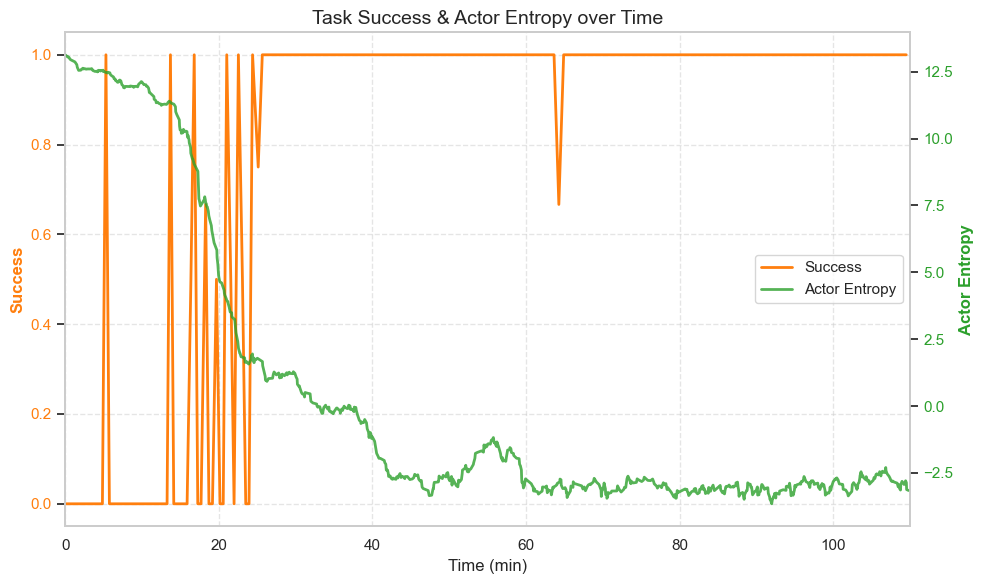
Training Curve
Peg Insertion