
RL Token: Bootstrapping Online RL with Vision-Language-Action Models#
RL Token: Bootstrapping Online RL with Vision-Language-Action Models trains a compact reinforcement-learning policy on top of a frozen VLA feature model. In RLinf configs and code, this workflow is abbreviated as RLT. It has two stages:
Train a VLA checkpoint together with an RLT token transformer on demonstration data.
Freeze that feature model and train a lightweight off-policy actor-critic policy using the extracted RLT state.
The checked-in example currently targets Franka peg insertion, while the pipeline itself is not tied to that task. A simulator version can reuse the same Stage 1 / Stage 2 split once the environment, action shape, state selection, and data paths are swapped.
Official project page: Precise Manipulation with Efficient Online RL.
Overview#
RLT separates representation learning from online RL control.
VLA SFT + RLT token transformer
Compact off-policy actor-critic
z_rl + proprio + reference chunk
Real robot now, simulator-ready layout
Provided Configuration Files#
Stage |
Config |
Purpose |
|---|---|---|
Stage 1 |
|
SFT pi0.5 together with the RLT token transformer. |
Stage 2 |
|
Run RLT Stage 2 actor-critic training with the frozen Stage 1 feature model. |
Installation#
1. Clone RLinf Repository#
# For mainland China users, you can use the following for better download speed:
# git clone https://ghfast.top/github.com/RLinf/RLinf.git
git clone https://github.com/RLinf/RLinf.git
cd RLinf
2. Install Dependencies#
Option 1: Docker Image
docker run -it --rm --gpus all \
   --shm-size 20g \
   --network host \
   --name rlinf \
   -v .:/workspace/RLinf \
   rlinf/rlinf:agentic-rlinf0.2-maniskill_libero
   # For mainland China users, you can use the following for better download speed:
   # docker.1ms.run/rlinf/rlinf:agentic-rlinf0.2-maniskill_libero
Please switch to the OpenPI virtual environment via the built-in switch_env utility:
source switch_env openpi
Option 2: Custom Environment
# For mainland China users, you can add the `--use-mirror` flag to the install.sh command for better download speed.

bash requirements/install.sh embodied --model openpi --env maniskill_libero
source .venv/bin/activate
How RLT Works#
Stage 1: Learn the RLT Feature Model#
Stage 1 starts from a VLA checkpoint and optimizes two objectives from the same demonstration batch:
The normal VLA action objective, reported as
vla_loss.The RLT token objective, reported as
rlt_loss.
The total Stage 1 loss is:
total_loss = rlt_loss + rlt_alpha * vla_loss
The OpenPI model exposes the VLA prefix hidden states. The RLT token
transformer reads those prefix states and produces a compact vector z_rl.
Stage 2 uses z_rl as the learned RL representation rather than training the
actor-critic directly on image observations.
Important Stage 1 fields:
# examples/sft/config/rlt_stage1_sft_openpi_pi05.yaml
data:
  train_data_paths: "/path/to/data"

actor:
  openpi_data:
    repo_id: "realworld_peg_insertion_rlt_stage1"
  model:
    model_type: "openpi"
    is_lora: False
    model_path: "/path/to/model"
    num_action_chunks: 20
    openpi:
      config_name: "pi05_franka_state"
      num_images_in_input: 1
      use_rlt: True
      rlt_alpha: 1.0
      rlt_prefix_seq_len: 1024
      rlt_image_only: False
      rlt_use_mask: True
Keep repo_id and config_name consistent with the normalization stats and
the Stage 2 feature-model config.
Stage 2: Train the Actor-Critic Policy#
Stage 2 freezes the Stage 1 feature model and trains only the compact RLT MLP actor and critic.
Note
The current Stage 2 implementation is not standard maximum-entropy SAC.
During rollout:
The environment returns raw observations and task metadata.
rollout.rlt_feature_modelruns the frozen Stage 1 model and converts the raw observation into:z_rl: the compact RLT representation.proprio: the selected robot or simulator state.ref_chunk: the VLA reference action chunk.
The Stage 2 actor consumes
ref_chunk,z_rl, andproprio.The replay buffer stores RLT transitions:
curr_obs = {z_rl, proprio, ref_chunk}
action   = action actually sent to the environment
next_obs = {next_z_rl, next_proprio, next_ref_chunk}
For the provided real-robot config, keyboard_reward_wrapper:
rlt_policy_switch adds an rlt_switch_flags flag. Before the operator presses
b, the executed action is the VLA ref_chunk; after b is pressed,
the executed action switches to the Stage 2 actor. Simulator configs can omit
this wrapper or replace it with an automatic switching rule.
The critic is trained with a TD target over chunked rewards. Rewards inside the action chunk are discounted and then bootstrapped with the next-state Q value:
target_q = discounted_chunk_reward + gamma ** chunk_horizon * Q_target(next_obs, next_action)
If the episode terminates and bootstrap_type is standard, the bootstrap
term is removed.
Important Stage 2 fields:
# examples/embodiment/config/rlt_stage2_ac_mlp.yaml
algorithm:
loss_type: rlt_ac
q_weight: 0.1
bc_weight: 5
reference_dropout_prob: 0.5
gamma: 0.96
entropy_tuning:
alpha_type: fixed_alpha
initial_alpha: 0.0
rollout:
collect_transitions: True
model:
model_path: null
precision: ${actor.model.precision}
action_dim: ${actor.model.action_dim}
num_action_chunks: ${actor.model.num_action_chunks}
ref_num_action_chunks: ${actor.model.ref_num_action_chunks}
rlt_feature_model:
model_type: "openpi"
model_path: "/path/to/stage1/checkpoint"
openpi_data:
repo_id: "realworld_peg_insertion_rlt_stage1"
openpi:
config_name: "pi05_franka_state"
num_images_in_input: 1
action_chunk: ${actor.model.ref_num_action_chunks}
state_indices: [] # keep the full raw state, e.g. 19D
use_rlt: True
rlt_prefix_seq_len: 1024
rlt_image_only: False
rlt_use_mask: True
actor:
model:
model_type: "rlt_mlp_policy"
precision: fp32
add_value_head: False
add_q_head: True
q_head_type: "default"
fixed_std: 0.002
is_lora: False
z_dim: 2048
proprio_dim: 19
action_dim: 7
num_action_chunks: 10
ref_num_action_chunks: 20
env:
train:
keyboard_reward_wrapper:
rlt_policy_switch
The Stage 2 actor loss is:
actor_loss = -q_weight * Q(obs, pi(obs)) + bc_weight * BC(pi(obs), target_action)
The BC target is the VLA reference action for normal policy steps. If a human intervention action is stored for a step, the BC target for that step becomes the human action.
Run the Provided Franka Example#
Data: Collect Franka Demonstrations and Compute Normalization Stats#
Stage 1 expects a Franka demonstration dataset in LeRobot format; the dataset
directory should directly contain data/ and meta/. On the controller
node, follow the data-collection flow in the Franka real-world guide to prepare the robot and target pose, and export LeRobot
data from the collection config:
env:
  data_collection:
    enabled: True
    export_format: "lerobot"
Then launch collection:
bash examples/embodiment/collect_data.sh realworld_collect_data
After collection, place the LeRobot dataset on the training node and compute
normalization statistics for the RLT OpenPI dataconfig. repo_id should
match actor.openpi_data.repo_id and
rollout.rlt_feature_model.openpi_data.repo_id in the Stage 1 / Stage 2
configs:
export HF_LEROBOT_HOME=/path/to/lerobot_root
python toolkits/lerobot/calculate_norm_stats.py \
    --config-name pi05_franka_state \
    --repo-id realworld_peg_insertion_rlt_stage1
Then point data.train_data_paths in the Stage 1 config at that LeRobot
dataset directory.
Stage 1: Train the RLT Feature Model#
Edit the Stage 1 config paths before launch:
data:
  train_data_paths: /path/to/lerobot_dataset

actor:
  openpi_data:
    repo_id: "realworld_peg_insertion_rlt_stage1"
  model:
    model_path: /path/to/model
    openpi:
      config_name: "pi05_franka_state"
      num_images_in_input: 1
      rlt_prefix_seq_len: 1024
Launch SFT:
bash examples/sft/run_vla_sft.sh rlt_stage1_sft_openpi_pi05
The saved checkpoint directory should look like:
logs/<run-name>/checkpoints/global_step_<step>
Use this directory as rollout.rlt_feature_model.model_path in Stage 2.
Do not put the Stage 1 checkpoint under rollout.model.model_path or
actor.model.model_path; those fields do not load the Stage 1 feature model.
Stage 2: Run RLT Actor-Critic#
Edit the Stage 2 config:
rollout:
  model:
    model_path: null
  rlt_feature_model:
    model_path: /path/to/stage1/checkpoint
    openpi_data:
      repo_id: "realworld_peg_insertion_rlt_stage1"
    openpi:
      config_name: "pi05_franka_state"
      num_images_in_input: 1
      state_indices: []
      rlt_prefix_seq_len: 1024

cluster:
  node_groups:
    - label: <gpu_node_group>
      node_ranks: <gpu_node_rank>
    - label: <env_node_group>
      node_ranks: <env_node_rank>
      hardware:
        type: <robot_type>
        configs:
          - robot_ip: <robot_ip>

env:
  train:
    keyboard_reward_wrapper: rlt_policy_switch
    override_cfg:
      target_ee_pose: [<target_x>, <target_y>, <target_z>, <target_roll>, <target_pitch>, <target_yaw>]
Launch the async run from the master node:
bash examples/embodiment/run_realworld_async.sh rlt_stage2_ac_mlp
The default keyboard module implements the key phase switch used by RLT: press
b to enter the Stage 2 actor-controlled phase. Other behavior can be
customized for the task in
rlinf/envs/realworld/common/wrappers/keyboard_rlt_policy_switch_wrapper.py.
Replay Buffer Behavior#
For loss_type: rlt_ac, the replay buffer does not store raw image
observations as the RL state. The environment worker waits for the rollout
worker to return RLT features and stores those features as transitions.
This means:
Steps before a real-robot policy switch are still useful. Their executed action is the VLA reference action, and their transition is stored in the same replay buffer.
Steps after the switch use the actor action and are also stored with the same RLT observation format.
sample_window_sizecontrols the recent transition window sampled from the replay buffer. It does not need to matchmax_steps_per_rollout_epoch.max_steps_per_rollout_epochcontrols how many environment steps are collected before the rollout worker flushes a batch to training.
Monitoring#
For metric definitions, see Training metrics. Useful RLT signals:
Stage 1 SFT:
vla_loss: the OpenPI action-prediction loss.rlt_loss: the RLT token reconstruction/compression loss.
Stage 2 actor-critic:
train/sac/critic_loss: Q-function TD loss.train/sac/actor_loss: combined-Q + BCactor objective.q_piandq_value_*: learned Q-values for actor and critic heads.bc_loss,bc_ref_loss,bc_human_loss: BC regularization terms.train/replay_buffer/size: number of stored replay transitions.env/success_onceandenv/episode_len: task outcome metrics.
Experimental Results#
The RL Token training result on the peg_insertion task in RLinf is shown below.
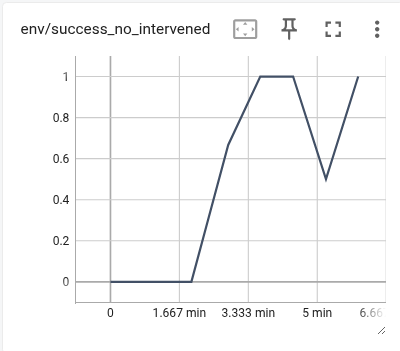
RL Token training result on the RLinf peg_insertion task
Practical Notes#
Keep Stage 1 and Stage 2 data settings consistent:
repo_id,config_name,action_dim,proprio_dim,ref_num_action_chunks, andz_dimmust agree. To keep the full raw state, usestate_indices: [].rollout.rlt_feature_modelshould point to the Stage 1 checkpoint, whileactor.modelis the Stage 2 MLP policy updated by the actor-critic worker.rollout.modelis the synced Stage 2 MLP copy on rollout workers. Keeprollout.model.model_path: nullfor scratch Stage 2 training; userunner.resume_dirto resume a Stage 2 run orrunner.ckpt_pathto load a single Stage 2 weight file.Do not configure
actor.model.model_pathfor Stage 1.actor.modelonly describes the Stage 2 MLP input/output shape and Q-head settings.keyboard_reward_wrapper: rlt_policy_switchis only needed for operator-controlled critical-phase switching.To add a simulator example, create a simulator environment config, keep
loss_type: rlt_acandrollout.rlt_feature_model, and replace the real-robot phase-switching logic with simulator-appropriate behavior.