
RL Token:借助视觉-语言-动作模型启动在线强化学习#
RL Token: Bootstrapping Online RL with Vision-Language-Action Models 在冻结的 VLA 特征模型之上训练一个轻量级强化学习策略。在 RLinf 的配置和代码中,这套流程简称为 RLT。整个流程分为两个阶段:
在示范数据上联合训练 VLA 检查点和 RLT token transformer。
冻结第一阶段得到的特征模型,用提取出的 RLT 状态训练一个轻量级 off-policy actor-critic。
当前仓库中的示例配置面向 Franka peg insertion 和 ManiSkill
PegInsertionSideWideClearance-v1 joint-control 仿真。pipeline 本身不绑定
具体任务;只要示范数据、环境配置、动作维度、状态语义和 OpenPI dataconfig 对齐,
就可以复用相同的两阶段结构。
官方项目页:Precise Manipulation with Efficient Online RL。
概览#
RLT 将表示学习和在线 RL 控制拆开。
VLA SFT + RLT token transformer
轻量级 off-policy actor-critic
z_rl + proprio + reference chunk
Franka 真机 / ManiSkill 仿真
提供的配置文件#
阶段 |
配置 |
作用 |
|---|---|---|
Franka Stage 1 |
|
在 Franka 示范数据上联合 SFT π₀.₅ 和 RLT token transformer。 |
Franka Stage 2 |
|
使用冻结的 Stage 1 特征模型,在真机上训练 RLT actor-critic。 |
ManiSkill Stage 1 |
|
联合训练 ManiSkill OpenPI 基座和 RLT token transformer。 |
ManiSkill Stage 2 |
|
使用自动 |
安装#
1. 克隆 RLinf 仓库#
# 为提高国内下载速度,可以使用:
# git clone https://ghfast.top/github.com/RLinf/RLinf.git
git clone https://github.com/RLinf/RLinf.git
cd RLinf
2. 安装依赖#
方式一:Docker 镜像
docker run -it --rm --gpus all \
   --shm-size 20g \
   --network host \
   --name rlinf \
   -v .:/workspace/RLinf \
   rlinf/rlinf:agentic-rlinf0.2-maniskill_libero
   # 为提高国内下载速度,可以使用:
   # docker.1ms.run/rlinf/rlinf:agentic-rlinf0.2-maniskill_libero
进入容器后,切换到 OpenPI 虚拟环境:
source switch_env openpi
方式二:自建环境
# 为提高国内依赖安装速度,可以添加 `--use-mirror` 到下面的 install.sh 命令

bash requirements/install.sh embodied --model openpi --env maniskill_libero
source .venv/bin/activate
RLT 如何工作#
Stage 1:学习 RLT 特征模型#
Stage 1 从一个 VLA 检查点开始,在同一批示范数据上优化两个目标:
普通 VLA 动作预测目标,日志中记为
vla_loss。RLT token 目标,日志中记为
rlt_loss。
Stage 1 的总损失为:
total_loss = rlt_loss + rlt_alpha * vla_loss
OpenPI 模型会暴露 VLA prefix hidden states。RLT token transformer 读取这些 prefix states,并输出紧凑向量 z_rl。Stage 2 使用 z_rl 作为学习到的 RL 表示,而不是直接在图像观测上训练 actor-critic。
Stage 1 中比较关键的字段:
# examples/sft/config/realworld_rlt_stage1_sft_openpi_pi05.yaml
data:
  train_data_paths: "/path/to/data"

actor:
  model:
    openpi_data:
      repo_id: "realworld_peg_insertion_rlt_stage1"
    model_type: "openpi"
    is_lora: False
    model_path: "/path/to/model"
    num_action_chunks: 20
    openpi:
      config_name: "pi05_franka_state"
      num_images_in_input: 1
      use_rlt: True
      rlt_alpha: 1.0
      rlt_prefix_seq_len: 1024
      rlt_image_only: False
      rlt_use_mask: True
repo_id、config_name 和归一化统计需要与 Stage 2 特征模型配置保持一致。
openpi_data 应写在 actor.model 下。
备注
ManiSkill joint 示例不依赖 state_indices 手工切片。pi05_rlt_maniskill_joint
dataconfig 将 LeRobot 数据中的 state 映射到 OpenPI observation.state;
Stage 2 rollout 也使用 OpenPI 处理后的 observation.state 作为 proprio。
这样 Stage 1、Stage 2 和 OpenPI normalization 看到的是同一种状态语义。
Stage 2:训练 Actor-Critic 策略#
Stage 2 冻结 Stage 1 特征模型,只训练轻量级 RLT MLP actor 和 critic。
备注
当前 Stage 2 实现不是标准 maximum-entropy SAC。
rollout 时:
环境返回原始观测和任务元信息。
rollout.rlt_feature_model运行冻结的 Stage 1 模型,将原始观测转换为:z_rl:紧凑的 RLT 表示。proprio:选中的机器人或仿真状态。ref_chunk:VLA reference action chunk。
Stage 2 actor 的输入是
ref_chunk、z_rl和proprio。replay buffer 存储 RLT transition:
curr_obs = {z_rl, proprio, ref_chunk}
action   = 实际发送给环境的动作
next_obs = {next_z_rl, next_proprio, next_ref_chunk}
Franka 真机配置中,keyboard_reward_wrapper: rlt_policy_switch 会提供
rlt_switch_flags 标记。在操作员按下 b 之前,实际执行 VLA 的
ref_chunk;按下 b 之后,实际执行 Stage 2 actor 的动作。
ManiSkill joint 配置中,env.*.rlt_policy_switch 使用任务信息自动产生
rlt_switch_flags``(actor/ref 阶段)和 ``intervene_flag``(expert 接管请求)。
HF rollout route 根据这些标记在整 chunk 级别选择 actor action、VLA
``ref_chunk
或 expert action,并把 record_transition、actor_switch 和
intervention_requested 写入 forward_inputs,供 replay 和监控使用。
critic 使用 chunked rewards 上的 TD target。一个 action chunk 内的奖励会先按折扣累计,然后用下一状态 Q 值 bootstrap:
target_q = discounted_chunk_reward + gamma ** chunk_horizon * Q_target(next_obs, next_action)
如果 episode 已终止,并且 bootstrap_type 为 standard,则不会加入 bootstrap 项。
Stage 2 中比较关键的字段:
# examples/embodiment/config/realworld_rlt_stage2_ac_mlp.yaml
algorithm:
  loss_type: rlt_ac
  q_weight: 0.1
  bc_weight: 5
  reference_dropout_prob: 0.5
  gamma: 0.96
  entropy_tuning:
    alpha_type: fixed_alpha
    initial_alpha: 0.0

rollout:
  collect_transitions: True
  model:
    model_path: null
    precision: ${actor.model.precision}
    action_dim: ${actor.model.action_dim}
    num_action_chunks: ${actor.model.num_action_chunks}
    ref_num_action_chunks: ${actor.model.ref_num_action_chunks}
  rlt_feature_model:
    model_type: "openpi"
    model_path: "/path/to/stage1/checkpoint"
    openpi_data:
      repo_id: "realworld_peg_insertion_rlt_stage1"
      norm_stats_path: /path/to/lerobot_dataset/norm_stats.json
    openpi:
      config_name: "pi05_franka_state"
      num_images_in_input: 1
      action_chunk: ${actor.model.ref_num_action_chunks}
      state_indices: []      # 保留完整 raw state;例如 19D state
      use_rlt: True
      rlt_prefix_seq_len: 1024
      rlt_image_only: False
      rlt_use_mask: True

actor:
  model:
    model_type: "rlt_mlp_policy"
    precision: fp32
    add_value_head: False
    add_q_head: True
    q_head_type: "default"
    fixed_std: 0.002
    is_lora: False
    z_dim: 2048
    proprio_dim: 19
    action_dim: 7
    num_action_chunks: 10
    ref_num_action_chunks: 20

env:
  train:
    keyboard_reward_wrapper: rlt_policy_switch
Stage 2 的 actor loss 为:
actor_loss = -q_weight * Q(obs, pi(obs)) + bc_weight * BC(pi(obs), target_action)
普通 policy step 中,BC target 是 VLA reference action。如果某一步存了
human intervention action,那么这一步的 BC target 会切换成人类动作。ManiSkill
默认关闭 expert_takeover,因此默认路线只使用 VLA reference 和 actor action。
运行当前 Franka 示例#
数据:采集 Franka 示范并计算归一化统计#
Stage 1 需要 LeRobot 格式的 Franka 示范数据,数据目录应直接包含
data/ 和 meta/。在控制节点上按照 Franka 真机文档 的数据采集流程准备机器人和目标位姿,并在采集配置中导出
LeRobot 格式数据:
env:
  data_collection:
    enabled: True
    export_format: "lerobot"
然后启动采集:
bash examples/embodiment/collect_data.sh realworld_collect_data
采集完成后,将 LeRobot 数据集放到训练节点,并为当前 RLT OpenPI dataconfig
计算归一化统计。repo_id 需要与 Stage 1 / Stage 2 配置中的
actor.openpi_data.repo_id 和 rollout.rlt_feature_model.openpi_data.repo_id 保持一致:
export HF_LEROBOT_HOME=/path/to/lerobot_root
python toolkits/lerobot/calculate_norm_stats.py \
    --config-name pi05_franka_state \
    --repo-id realworld_peg_insertion_rlt_stage1
后续将 Stage 1 配置中的 data.train_data_paths 指向该 LeRobot 数据集目录。若 checkpoint 未包含 norm stats,可在 openpi_data 中设置 norm_stats_path 指向 norm_stats.json。
Stage 1:训练 RLT 特征模型#
启动前先修改 Stage 1 配置中的路径:
data:
  train_data_paths: /path/to/lerobot_dataset

actor:
  openpi_data:
    repo_id: "realworld_peg_insertion_rlt_stage1"
  model:
    model_path: /path/to/model
    openpi:
      config_name: "pi05_franka_state"
      num_images_in_input: 1
      rlt_prefix_seq_len: 1024
启动 SFT:
bash examples/sft/run_vla_sft.sh realworld_rlt_stage1_sft_openpi_pi05
保存出的检查点目录通常形如:
logs/<run-name>/checkpoints/global_step_<step>
Stage 2 中需要将这个目录填到 rollout.rlt_feature_model.model_path。
不要把 Stage 1 checkpoint 填到 rollout.model.model_path 或
actor.model.model_path;这两个位置不负责加载 Stage 1 特征模型。
Stage 2:运行 RLT Actor-Critic#
修改 Stage 2 配置:
rollout:
  model:
    model_path: null
  rlt_feature_model:
    model_path: /path/to/stage1/checkpoint
    openpi_data:
      repo_id: "realworld_peg_insertion_rlt_stage1"
    openpi:
      config_name: "pi05_franka_state"
      num_images_in_input: 1
      state_indices: []
      rlt_prefix_seq_len: 1024

cluster:
  node_groups:
    - label: <gpu_node_group>
      node_ranks: <gpu_node_rank>
    - label: <env_node_group>
      node_ranks: <env_node_rank>
      hardware:
        type: <robot_type>
        configs:
          - robot_ip: <robot_ip>

env:
  train:
    keyboard_reward_wrapper: rlt_policy_switch
    override_cfg:
      target_ee_pose: [<target_x>, <target_y>, <target_z>, <target_roll>, <target_pitch>, <target_yaw>]
在 master node 上启动异步训练:
bash examples/embodiment/run_realworld_async.sh realworld_rlt_stage2_ac_mlp
当前默认键盘模块实现了 RLT 算法中的关键阶段切换:按 b 进入 Stage 2 actor
控制阶段。其他功能可根据具体任务需求进行定制
(rlinf/envs/realworld/common/wrappers/keyboard_rlt_policy_switch_wrapper.py)。
运行 ManiSkill Joint 示例#
ManiSkill joint 示例使用 PegInsertionSideWideClearance-v1、RGB 双视角观测、
Panda 前 9 维 qpos 和 8 维 pd_joint_delta_pos action。每个 Stage 2 action
是 10-step chunk,语言指令固定为 insert the peg in the hole。
数据:准备 joint-control LeRobot 数据#
Stage 1 和 Stage 2 的 OpenPI feature model 使用
pi05_rlt_maniskill_joint dataconfig。LeRobot 数据集至少需要包含:
字段 |
含义 |
|---|---|
|
主视角 RGB 图像。 |
|
wrist RGB 图像。 |
|
Panda joint proprio,当前示例使用 9 维状态。 |
|
8 维 |
|
语言指令;也可以通过 |
可以直接使用参考数据集
RLinf/rlt-maniskill-PegInsertionSide-v1-400-succ。
它包含 ManiSkill PegInsertionSideWideClearance-v1 的成功演示,动作空间为
pd_joint_delta_pos,并使用上表中的 joint-control LeRobot 字段。
export HF_LEROBOT_HOME=/path/to/lerobot_root
huggingface-cli download RLinf/rlt-maniskill-PegInsertionSide-v1-400-succ \
    --repo-type dataset \
    --local-dir ${HF_LEROBOT_HOME}/maniskill_peginsertionside_joint
也可以用当前仓库中的采集脚本重新生成数据。该脚本会先调用 ManiSkill Panda
motion-planning solver 生成成功轨迹,再把 pd_joint_pos solver action 转成
pd_joint_delta_pos action,并只保存 replay 成功的 episode:
python toolkits/lerobot/collect_maniskill_peg_lerobot_joint.py \
    --repo-id maniskill_peginsertionside_joint \
    --num-episodes 400 \
    --seed 0 \
    --max-attempts 4000 \
    --overwrite
备注
采集脚本位于 toolkits/lerobot,用于 RLT joint 数据准备。
它依赖 ManiSkill 的 PegInsertionSide Panda motion-planning solver;如果运行时报
solver import 错误,请先确认当前 ManiSkill 安装包含 motion-planning 示例。
计算归一化统计时,--config-name 和 --repo-id 要与训练配置保持一致:
export HF_LEROBOT_HOME=/path/to/lerobot_root
python toolkits/lerobot/calculate_norm_stats.py \
    --config-name pi05_rlt_maniskill_joint \
    --repo-id maniskill_peginsertionside_joint
警告
Stage 1 checkpoint、Stage 2 rollout.rlt_feature_model 和 OpenPI assets
必须使用同一套 norm_stats.json。如果 SFT 基座和 Stage 2 加载了不同
repo_id 下的 norm stats,VLA reference action 的尺度会发生偏移。可通过 openpi_data.norm_stats_path 显式指定上述 norm_stats.json 路径。
Stage 1:联合训练 ManiSkill OpenPI + RLT 特征模型#
修改 examples/sft/config/maniskill_rlt_stage1_sft_openpi_pi05.yaml 中的数据路径:
data:
  train_data_paths:
    - dataset_path: /path/to/maniskill_peginsertionside_joint
      weight: 1.0

actor:
  model:
    model_path: /path/to/pi05_base
    openpi:
      config_name: pi05_rlt_maniskill_joint
    openpi_data:
      repo_id: maniskill_peginsertionside_joint
      default_prompt: insert the peg in the hole
      norm_stats_path: /path/to/maniskill_peginsertionside_joint/norm_stats.json
启动训练:
bash examples/sft/run_vla_sft.sh maniskill_rlt_stage1_sft_openpi_pi05
保存出的 FSDP 检查点通常形如:
logs/<run-name>/checkpoints/global_step_<step>/actor
Stage 2 中需要将这个 actor 目录直接填到
rollout.rlt_feature_model.model_path,例如
/path/to/maniskill_rlt_stage1_sft_openpi_pi05/checkpoints/global_step_<step>/actor。
Stage 2:运行 ManiSkill RLT Actor-Critic#
修改 examples/embodiment/config/maniskill_rlt_stage2_ac_mlp.yaml 中的
Stage 1 checkpoint:
env:
  train:
    wrap_obs_mode: rlt_openpi_joint
    rlt_policy_switch:
      enable: True
      task_mode: full_task
      trigger_mode: auto
  eval:
    wrap_obs_mode: rlt_openpi_joint
    rlt_policy_switch:
      enable: True
      task_mode: full_task
      trigger_mode: auto

rollout:
  rlt_feature_model:
    model_path: /path/to/maniskill_rlt_stage1_sft_openpi_pi05/checkpoints/global_step_<step>/actor
    openpi_data:
      repo_id: maniskill_peginsertionside_joint
      norm_stats_path: /path/to/maniskill_peginsertionside_joint/norm_stats.json
    openpi:
      config_name: pi05_rlt_maniskill_joint
  expert_model:
    model_path: /path/to/rlt_maniskill_joint_pi05_sft/checkpoints/global_step_<step>/actor
    precision: null
    openpi:
      use_rlt: False
启动训练:
bash examples/embodiment/run_embodiment.sh maniskill_rlt_stage2_ac_mlp
这个配置会启动 actor、rollout 和 ManiSkill env。rollout 侧冻结
rollout.rlt_feature_model,只同步和执行 Stage 2 MLP actor。ManiSkill route
在 ready_for_online 之前执行 VLA ref_chunk;达到
algorithm.rlt_schedule.warmup_post_collect_updates 后,才允许 actor 在自动
critical phase 中接管。
调节 ManiSkill Critical Phase 和 Intervention#
ManiSkill 的切换逻辑是仿真专用的。它读取 peg insertion 任务信息来打开
rlt_switch_flags / in_critical_phase;如果启用 expert takeover,它还会在
actor 连续几个 chunk 没有进展时请求 expert 接管。下面的注释只用于文档说明,
不要写进实际 YAML 文件。
algorithm:
  rlt_schedule:
    enable: True                    # 使用 ManiSkill rollout / update budget。
    warmup_post_collect_updates: 30000  # actor 上线前需要完成的 update 数。
    train_every_transitions: 5       # 每 N 条已记录 transition 增加训练预算。
  actor_weight_schedule:
    enable: True                    # 使用 BC/Q 权重 ramp,而不是固定权重。
    warmup_updates: 20000           # warmup BC/Q 权重保持的 update 数。
    ramp_updates: 50000             # 逐步过渡到 online BC/Q 权重。

env:
  train:
    rlt_policy_switch:
      task_mode: full_task          # critical phase 前用 VLA,里面用 actor。
      trigger_mode: auto            # 根据任务信息自动计算 critical phase。
      latch_until_done: True        # 一旦进入 critical phase 就保持 actor 控制。
      auto_gate:
        require_grasp: True         # 抓住 peg 后才允许进入。
        require_not_success: True   # 已成功时不再切到 actor。
        near_hole_x_min: -0.16      # 值越大,x 方向进入门控越窄。
        near_hole_yz_margin: 1.5    # 值越大,y/z 进入窗口越宽。
      expert_takeover:
        enable: True                # 只在 train rollout 中启用仿真 expert 干预。
        trigger_mode: stalled_progress  # 连续无进展 chunk 后才接管。
        gate:
          near_hole_x_min: -0.10    # 足够靠近洞口后才检查是否卡住。
          near_hole_yz_margin: 2.0  # y/z 足够接近后才检查是否卡住。
          stuck_chunks_before_takeover: 3  # 接管前需要的无进展 chunk 数。
          min_x_progress: 0.003     # 能重置 stall 计数的前向进展。
          min_yz_progress: 0.0015   # 能重置 stall 计数的对齐进展。
          min_score_progress: 0.002 # 能重置 stall 的综合分数进展。
          progress_yz_weight: 1.0   # 综合进展分数里的 y/z 惩罚权重。

  eval:
    rlt_policy_switch:
      expert_takeover:
        enable: False               # eval 只测 base policy + actor,不用 expert。
可选:启用 ManiSkill Expert Takeover#
ManiSkill expert takeover 默认关闭。需要在 critical phase 中用更强的 SFT expert 替换 actor action,并把 expert action 作为 intervention target 写入 replay 时, 再打开这个路径:
rollout:
  expert_model:
    model_path: /path/to/rlt_maniskill_joint_pi05_sft/checkpoints/global_step_<step>/actor
    precision: null
    openpi:
      use_rlt: False

env:
  train:
    rlt_policy_switch:
      expert_takeover:
        enable: True
        trigger_mode: stalled_progress
        gate:
          stuck_chunks_before_takeover: 3
          min_x_progress: 0.003
          min_yz_progress: 0.0015
          min_score_progress: 0.002
          progress_yz_weight: 1.0
也可以把 rollout.expert_model.model_path 换成你自己训练得更充分的
joint-control SFT checkpoint。expert 的 OpenPI dataconfig 和 norm stats 需要和
Stage 2 数据保持一致。expert 只用于 train rollout;eval rollout 不会执行 expert takeover,评测的是学到的 actor。
Replay Buffer 逻辑#
当 loss_type: rlt_ac 时,replay buffer 不会把原始图像观测当作 RL 状态存储。
rollout worker 会返回 RLT 特征,learner 侧把这些特征组装成 transition:
curr_obs = {z_rl, proprio, ref_chunk}
action   = 实际发送给环境的 action chunk
next_obs = {next_z_rl, next_proprio, next_ref_chunk}
这意味着:
真机切换前的 step 仍然会用于训练。这些 step 的执行动作是 VLA reference action,transition 也会进入同一个 replay buffer。
切换后的 step 执行 actor action,并以相同的 RLT observation 格式存储。
ManiSkill route 在整 chunk 级别选择 actor action 或 VLA
ref_chunk,replay 中的action始终是实际执行的动作。ManiSkill learner 会把 rollout chunk 切成 1-sample transition trajectory,再放进 RLinf
TrajectoryReplayBuffer。sample_window_size控制从 replay buffer 近期窗口中采样的范围,不需要和max_steps_per_rollout_epoch一致。max_steps_per_rollout_epoch控制一次 rollout flush 到训练侧之前收集多少环境 step。
监控指标#
指标定义见 训练指标。RLT 中比较有用的信号包括:
Stage 1 SFT:
vla_loss:OpenPI 动作预测损失。rlt_loss:RLT token 重建 / 压缩损失。
Stage 2 actor-critic:
critic/critic_loss:Q 函数 TD loss。actor/actor_loss:组合后的-Q + BCactor 目标。q_pi和q_value_*:actor 和 critic heads 上的 Q 值。actor/bc_loss、actor/bc_ref_loss、actor/bc_human_loss:BC 正则相关损失。actor/human_mask_ratio:当前训练 batch 中被标记为 expert 干预的比例(来自trajectory.intervene_flags)。train/replay_buffer/size:当前 replay transitions 数量。env/success_once和env/episode_len:任务结果指标。eval/success_once:固定 eval reset ids 上的成功率。
ManiSkill rollout / replay 诊断(由 actor 收到 trajectory 后统计):
train/replay/record_transition_rate:收集到的 step 中被保存为 RLT transition 的比例(来自forward_inputs.record_transition)。train/replay/actor_switch_rate:收集到的 step 中实际由 actor/student action 控制环境的比例(来自forward_inputs.actor_switch)。train/replay/intervention_requested_rate:env 请求 expert 接管的比例(来自forward_inputs.intervention_requested)。train/replay/intervention_rate:route 实际应用 expert action 的比例(来自trajectory.intervene_flags)。train/replay/transition_count、train/replay/reward_mean、train/replay/reward_positive_rate、train/replay/done_rate:当前 collect step 的 ManiSkill transition-replay 入库统计。
RLT schedule / learner backlog(ManiSkill
algorithm.rlt_schedule.enable):train/rlt/ready_for_online:learnerupdate_step是否已超过warmup_post_collect_updates。train/rlt/actor_updates_run、train/rlt/critic_updates_run和train/rlt/pending_update_budget:本 step 执行的 actor/critic 更新次数,以及剩余 learner backlog。train/rlt/updates_to_run、train/rlt/should_train和train/rlt/skip_reason:本 step 计划训练量,以及跳过训练的原因。train/rlt/global_transitions_since_train和train/rlt/global_total_transitions_added:自上次训练 burst 以来的全局 replay 入库计数。
实验结果#
在 RLinf 中的 peg_insertion 任务中利用 RL Token 训练结果如下图。
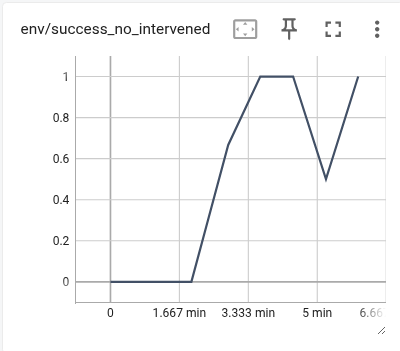
RLinf peg_insertion 任务中的 RL Token 训练结果
实践建议#
Stage 1 和 Stage 2 的数据配置必须保持一致:
repo_id、config_name、action_dim、proprio_dim、ref_num_action_chunks和z_dim都要对齐;如果保留完整 raw state,可使用state_indices: []。rollout.rlt_feature_model指向 Stage 1 检查点;actor.model是 actor-critic worker 会更新的 Stage 2 MLP 策略。rollout.model是 Stage 2 MLP 在 rollout worker 上的同步副本。Stage 2 从头训练时保持rollout.model.model_path: null;恢复 Stage 2 训练使用runner.resume_dir,加载单个 Stage 2 权重文件使用runner.ckpt_path。不要配置
actor.model.model_path来加载 Stage 1;actor.model只描述 Stage 2 MLP 的输入输出维度和 Q-head 设置。Stage 2 MLP 配置直接内联在各个 Stage 2 YAML 的
actor.model下,不再使用单独的 model defaults 文件。keyboard_reward_wrapper: rlt_policy_switch只在需要人工控制关键阶段切换时使用。ManiSkill joint 示例使用
env.*.rlt_policy_switch,不要再使用真机的 keyboard wrapper。ManiSkill 的
proprio来自 OpenPI processedobservation.state。如果新建仿真 dataconfig,需要同时检查数据集state、OpenPI transform 和 Stage 2proprio_dim。Stage 1、Stage 2 和 checkpoint assets 中的
norm_stats.json必须来自同一套数据语义和同一个repo_id。推荐通过openpi_data.norm_stats_path显式指定,避免 Stage 1 checkpoint 未写入 norm stats 时加载失败。rollout.rlt_feature_model.model_path应指向 Stage 1 FSDP 检查点下的actor目录,例如.../checkpoints/global_step_<step>/actor。添加仿真示例时,可以新建仿真环境配置,保留
loss_type: rlt_ac和rollout.rlt_feature_model,再把真机阶段切换逻辑替换成适合仿真的逻辑。